Listen Now: [14 min 18 sec]
Watch Vintage Newsreel Coverage of the Bonus Marchers

Bonus marchers fight with D.C. police at a camp on
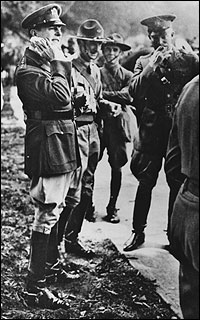
Douglas MacArthur led federal troops who burned the Bonus Army's camps. To his left, hand to face, is Dwight D. Eisenhower. General Douglas MacArthur Foundation
Weekend Edition Sunday, February 13, 2005 · Soldiers who served in World War I were paid $1 a day, plus a 25-cent stipend for every day spent overseas. In 1924, Congress passed a law calling for every veteran of The Great War to receive an additional dollar for every day served. But the payment was not due for 20 years.
With the advent of the Great Depression, frustration over the delayed bonus turned to anger. A new bill was introduced in Congress to pay the bonus immediately. And thousands of veterans gathered in the nation's capital to demand their money.
Author Paul Dickson says the violence that followed has often been overlooked, and the impact on the 1932 presidential election underestimated. He is the co-author of a new book entitled The Bonus Army: An American Epic.
Dickson believes that what happened to the Bonus Army made politicians think long and hard when WWII veterans began to return. The result was the GI Bill, which Dickson credits with propelling millions into the middle class and changing the very fabric of the
Revisiting the scene of the soldiers' camp on the
The Bonus Army, some 15,000 to 20,000 World War I veterans from across the country, marched on the Capitol in June 1932 to request early payment of cash bonuses due to them in 1945. The Great Depression had destroyed the economy, leaving many veterans jobless. Veteran Army Signal Corps photographer Theodor Horydczak, of Washington, D.C., photographed their camp site on the Mall. Six futile weeks of lobbying Congress raised government fears of riots, and on July 28, cavalry, infantry, tank troops and a mounted machine gun squadron commanded by General Douglas MacArthur and Major Dwight Eisenhower dispersed veterans and their families with bayonets and tear gas. Public opinion denounced President Herbert Hoover for the resulting bloodshed and helped force him from office.
The Bonus Army March


Theodor Horydczak (ca. 1870-1971)
Veterans Bonus March, Washington, July 1932
Gelatin silver photographs (58F.2a,b)
Prints & Photographs Division
Gift of Norma and
Francis Reeves, 1973
Digital ID#s ppmsca-05576, ppmsca-05577
 相关文章相关评论发表评论